AI feedback that sounded convincing but was generic or inaccurate was making my work harder. I created five open-source skills to make audits, critiques, discovery, design decisions, and frontend specifications more structured and verifiable.
AI Tools · Open Source · Claude · UX
Product Designer
Product Design · AI Tools
2026
Five AI skills to bring rigor to UX work
AI feedback that sounded convincing but was generic or inaccurate was making my work harder. I created five open-source skills to make audits, critiques, discovery, design decisions, and frontend specifications more structured and verifiable.
AI Tools · Open Source · Claude · UX
Context and problem
In screen critiques, responses such as "improve the visual hierarchy" or "the typography could be clearer" did not identify which principle had been compromised, which measurement supported the diagnosis, or which alternative to test. Some feedback started with appearance and only then tried to build a usability rationale.
Another problem was overconfidence: incorrect accessibility requirements, misattributed heuristics, and invented criteria. An authoritative tone could lead to recommendations being applied without verification.
Evidence and guiding principle
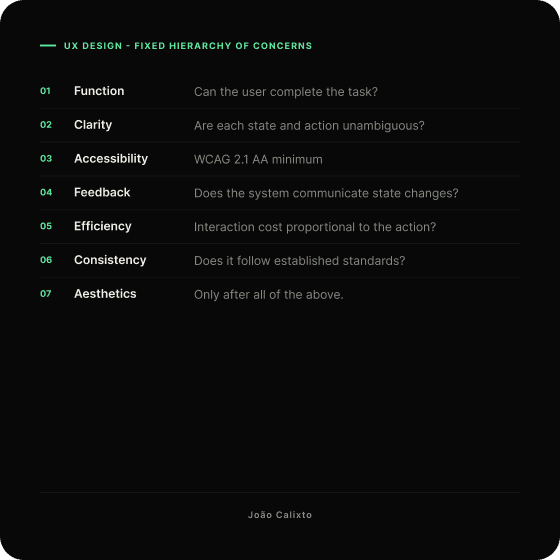
The starting point was observing these patterns in my own use, rather than quantitative adoption research. I defined a shared order: task completion, clarity, accessibility, feedback, efficiency, consistency, and finally aesthetics.
The toolkit draws on Nielsen’s heuristics, accessibility requirements, Fitts’s Law, and Gestalt principles. Citing a reference does not replace checking whether it applies to the problem.
The labels DATA, ESTIMATED, and INFERENCE distinguish verifiable measurements, estimates based on incomplete information, and interpretive conclusions. In Portuguese: dado, estimativa, and inferência.
Constraints and trade-offs
The skills needed to be useful across different contexts without turning every response into a generic checklist. The output needed to record evidence, explain limitations, and produce a concrete action. The instructions reduce ambiguity, but do not eliminate model errors or replace professional judgment.
Decisions and solution
UX Audit
Functional and accessibility auditing that checks tasks, available measurements, and applicable criteria. Each finding must identify evidence, impact, and action.
Design Critique
Structured critique that evaluates function and clarity before visual composition, avoiding aesthetic preferences presented as facts.
UX Design
Support for strategic design decisions, with explicit context, constraints, alternatives, and trade-offs.
Discovery
Structured discovery to organize the problem, hypotheses, research questions, and next steps, without treating assumptions as validation.
Frontend Spec
Frontend specification that records components, states, interactions, and implementation criteria, making design intent clearer for engineering.
Illustrative output samples
UX Design · Original image in English.
Illustrative sample of the evaluation structure: function, clarity, accessibility, feedback, efficiency, consistency, and aesthetics. This order belongs to the tool; it is not a universal standard.
Discovery · Original image in English.
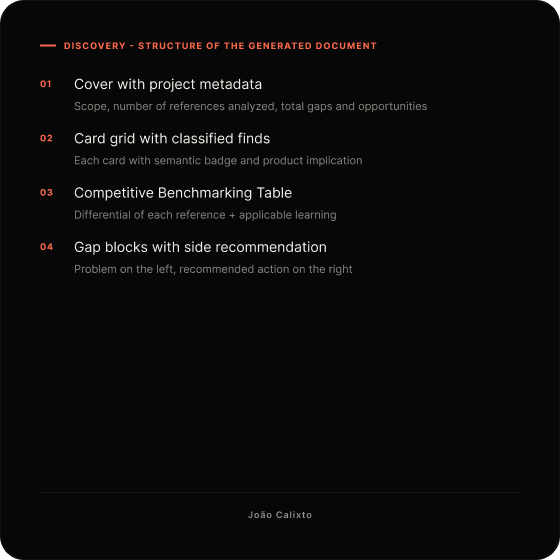
Illustrative sample with metadata, classified findings, benchmarking, and gaps or recommendations. The structure organizes information, but does not prove that research was conducted or turn hypotheses into validation.
The five skills were built, iterated on, and released on GitHub with documentation. They became part of my workflow. The benefit described is qualitative and personal; this case study presents no metrics for adoption, time saved, or product impact.
My role
I identified recurring problems in the AI feedback I received.
I defined the shared functional hierarchy and evidence labeling system.
I wrote and iterated on the five skills and their documentation.
I released the repository as open source.
Reflection
AI is more useful when it helps make reasoning and limitations explicit. Structured output still needs review: measurements, criteria, references, and context can be wrong. The next step is to observe use in other contexts before claiming adoption or productivity benefits.
Evidence and guiding principle
The starting point was observing these patterns in my own use, rather than quantitative adoption research. I defined a shared order: task completion, clarity, accessibility, feedback, efficiency, consistency, and finally aesthetics.
The toolkit draws on Nielsen’s heuristics, accessibility requirements, Fitts’s Law, and Gestalt principles. Citing a reference does not replace checking whether it applies to the problem.
The labels DATA, ESTIMATED, and INFERENCE distinguish verifiable measurements, estimates based on incomplete information, and interpretive conclusions. In Portuguese: dado, estimativa, and inferência.
Constraints and trade-offs
The skills needed to be useful across different contexts without turning every response into a generic checklist. The output needed to record evidence, explain limitations, and produce a concrete action. The instructions reduce ambiguity, but do not eliminate model errors or replace professional judgment.
Decisions and solution
UX Audit
Functional and accessibility auditing that checks tasks, available measurements, and applicable criteria. Each finding must identify evidence, impact, and action.
Design Critique
Structured critique that evaluates function and clarity before visual composition, avoiding aesthetic preferences presented as facts.
UX Design
Support for strategic design decisions, with explicit context, constraints, alternatives, and trade-offs.
Discovery
Structured discovery to organize the problem, hypotheses, research questions, and next steps, without treating assumptions as validation.
Frontend Spec
Frontend specification that records components, states, interactions, and implementation criteria, making design intent clearer for engineering.
Impact and limitations
The five skills were built, iterated on, and released on GitHub with documentation. They became part of my workflow. The benefit described is qualitative and personal; this case study presents no metrics for adoption, time saved, or product impact.
My role
I identified recurring problems in the AI feedback I received.
I defined the shared functional hierarchy and evidence labeling system.
I wrote and iterated on the five skills and their documentation.
I released the repository as open source.
Reflection
AI is more useful when it helps make reasoning and limitations explicit. Structured output still needs review: measurements, criteria, references, and context can be wrong. The next step is to observe use in other contexts before claiming adoption or productivity benefits.